
Micro-Culture Model : There was a moment when growth stopped feeling like progress.
The company was expanding. New teams were forming. New geographies were opening. On paper, everything looked like success.
But inside, something felt off.
Conversations started to sound different. Decisions slowed down. Energy varied from one team to another. What felt aligned in one office felt disconnected in another.
I remember sitting in a meeting at Kyyba, listening to two teams talk about the same goal in completely different ways. Both were right. Both were committed.
But they were not aligned.
That is when it became clear:
Culture does not scale the way revenue does. – Tel k Ganesan
The Core Realization
You cannot stretch one culture across every team and expect it to hold.
That realization did not come from strategy decks. It came from observing people, listening closely, and noticing subtle shifts in energy.
And that is where the idea of micro-cultures began.
“Culture doesn’t break suddenly—it drifts quietly when alignment fades.”
The Cinematic Meaning Behind Micro-Cultures
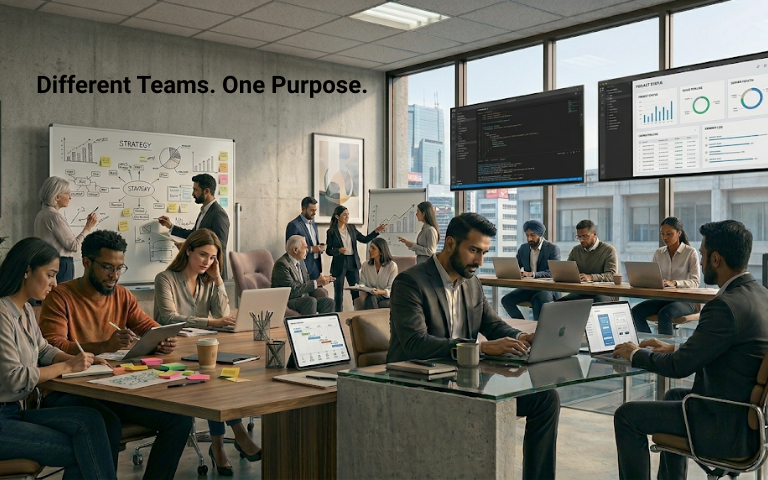
In powerful films, every group carries its own identity.
The mission is shared.
But the expression is different.
- One team leads with discipline
- Another with creativity
- Another with resilience
Yet all move toward the same outcome.
That is what a living organization looks like.
Initially, the instinct was to create one unified culture. One way of thinking. One way of operating.
It felt efficient. It felt controlled.
But as Kyyba expanded across industries and geographies, this model began to crack.
- Technology teams thought differently than media teams
- Creative teams needed a different rhythm than delivery teams
- Entrepreneurial ecosystems like TiE Detroit operated differently from corporate environments
Trying to force one culture across all these environments created friction.
It reduced authenticity. It slowed momentum.
That is when a deeper insight emerged:
Culture is not a monolith. It is a network.
“Alignment creates strength. Uniformity creates resistance.”
Tel Ganesan’s Interpretation
The micro-culture model is not about fragmentation. It is about intentional design.
At Kyyba, the shift happened when we stopped asking every team to behave the same way and started asking:
How will each team live the company’s values in their own context?
The values remained constant:
- Integrity
- Ownership
- Commitment to excellence
But their expression changed:
- In technology → precision and accountability
- In creative teams → bold thinking and emotional expression
- In TiE Detroit → collaboration and mentorship
This created something powerful.
People stopped trying to fit in.
They started taking ownership.
They started shaping their environment.
“People don’t connect to imposed culture. They connect to experienced culture.”
Leadership Insights
The micro-culture model requires a different kind of leadership.
It requires letting go of control without losing clarity.
Many leaders fear that multiple cultures create chaos.
But when designed intentionally, they create ownership.
Key truths:
- Alignment matters more than uniformity
- Culture is built in proximity (small teams, daily interactions)
- Trust grows stronger in smaller environments
But one condition is critical:
There must be a strong shared purpose.
Without it, micro-cultures drift apart.
With it, they stay connected.
Real-World Application
To apply the micro-culture model:
1. Define the Core Purpose
What connects every team?
2. Empower Teams
Let them define:
- How they work
- How they communicate
- How they express values
3. Build Local Leadership
Strong micro-cultures need strong team-level leaders.
4. Create Cross-Team Connection
Different identities, but shared direction.
5. Continuously Listen
Culture evolves. Leaders must stay close to people.
The Deeper Truth
Across Kyyba’s journey—technology, media, music—and civic initiatives in cities rebuilding trust:
One principle stays consistent:
People don’t connect to abstract culture.
They connect to what they experience daily.
Leadership Lessons
- Strong organizations are built through small, aligned communities
- Ownership increases when culture feels personal
- Diversity within alignment creates strength
Questions Worth Asking
- Are you forcing one culture across all teams?
- Or allowing teams to build environments where they thrive?
- Do your teams feel ownership?
- Or are they adapting to something imposed?
Final Thought
The future of organizations will not be defined by size.
It will be defined by how well they understand people.
Micro-cultures are not a compromise.
They are an evolution.
They allow organizations to:
- Stay human while scaling
- Stay connected while expanding
- Build systems that are meaningful, not just efficient
When leaders embrace this model, something shifts.
Teams stop trying to fit in.
They start showing up fully.
And over time, the organization becomes:
A network of living cultures.
Each unique.
Each aligned.
Each contributing to something bigger.